

Our Pipeline —
Radiodiagnostics & Radiotherapeutics
We’re advancing cancer and autoimmune disease treatment with two investigational granzyme B-guided radiopharmaceuticals, a radiodiagnostic and radiotherapeutic, each progressing through carefully planned clinical milestones.
Driving Innovation in Immunotherapy.
Radiodiagnostics (CSB-321)
Phase 1
Phase 1
IND Enabling
IND Enabling
Pre-Clinical
Discovery
Radiotherapeutics (CSB-421)
IND Enabling
IND Enabling
Pre-Clinical
Are you an Academic Investigator?
Peer-Reviewed Published Studies by Disease
The Challenge. Early after starting checkpoint therapy, CT/PET-FDG can’t reliably separate inflammation (pseudoprogression) from true tumor progression; responses vary lesion-by-lesion.
Our Breakthrough. In melanoma models and human samples, granzyme B (GzmB)–targeted PET probes distinguished responders from non-responders before volume change, and granzyme B levels were higher in biopsies from clinical responders—supporting granzyme B as an early, mechanistic biomarker.[I]-Investigational radiopharmaceuticals; not approved by the U.S. FDA or other regulators. Not available for commercial use. Safety and efficacy have not been established.</p><br /><br /><br /> <p>-Radiodiagnostic candidate (e.g., CSB-321) under clinical evaluation; performance characteristics are not established and not for diagnostic use outside clinical research.<br /><br /><br /><br />
What it Means for Researchers.
- Early on-mechanism PD signal. Lesion-level granzyme B signal to stratify likely responders and identify non-responding lesions sooner.[II]Radiodiagnostic candidate (e.g., CSB-321) under clinical evaluation; performance characteristics are not established and not for diagnostic use outside clinical research.
- Trial discipline. Basis for biomarker-enriched designs and earlier go/no-go decisions in melanoma IO combinations.[III]Forward-looking statements about potential clinical utility, study designs, and milestones are subject to risks and uncertainties and may change without notice.
What it Means for Patients.
- Faster clarity. Potential for earlier insight into whether your therapy is engaging tumors.[IV]Investigational radiopharmaceuticals; not approved by the U.S. FDA or other regulators. Not available for commercial use. Safety and efficacy have not been established.
- Targeted next steps. Information to focus on problem lesions while helping spare healthy tissue.[III]Forward-looking statements about potential clinical utility, study designs, and milestones are subject to risks and uncertainties and may change without notice.

The Challenge. Early after PD-1/PD-L1 therapy, size/FDG changes can reflect inflammation or mixed responses across lung lesions, making timely decisions hard.
Our Breakthrough. Granzyme B–targeted PET probes differentiated immune-active from immune-silent tumor microenvironments preclinically, supporting early, mechanistic readouts;[IV]Investigational radiopharmaceuticals; not approved by the U.S. FDA or other regulators. Not available for commercial use. Safety and efficacy have not been established. independent NSCLC data show that circulating GZMB levels are associated with clinical outcomes on checkpoint therapy.[II]Radiodiagnostic candidate (e.g., CSB-321) under clinical evaluation; performance characteristics are not established and not for diagnostic use outside clinical research.
What it Means for Researchers
- Early on-mechanism PD signal to stratify likely responders and flag non-responding lung lesions sooner.[IV]Investigational radiopharmaceuticals; not approved by the U.S. FDA or other regulators. Not available for commercial use. Safety and efficacy have not been established.
- Rationale for biomarker-enriched NSCLC IO trials and earlier go/no-go decisions.[III]Forward-looking statements about potential clinical utility, study designs, and milestones are subject to risks and uncertainties and may change without notice.
What it Means for Patients
- Potential for earlier insight into whether therapy is engaging lung tumors.[IV]Investigational radiopharmaceuticals; not approved by the U.S. FDA or other regulators. Not available for commercial use. Safety and efficacy have not been established.
- This information may help clinicians focus on problematic lesions while sparing healthy tissue.[III]Forward-looking statements about potential clinical utility, study designs, and milestones are subject to risks and uncertainties and may change without notice.
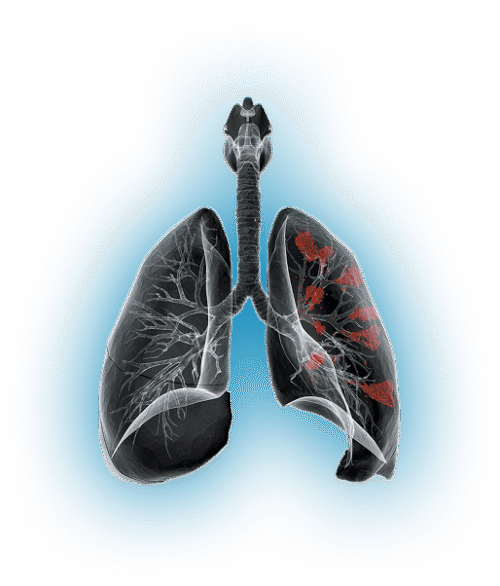
The Challenge. Clinical scores and intermittent endoscopy can miss intestinal inflammation when it is waxing or waning between visits.
Our Breakthrough. In murine colitis with human tissue correlates, 68Ga-NOTA-GZP PET detected active bowel inflammation and showed a decrease with anti-TNF treatment—supporting granzyme B as a mechanistic activity/readout biomarker.[V]-Investigational radiopharmaceuticals; not approved by the U.S. FDA or other regulators. Not available for commercial use. Safety and efficacy have not been established.</p><br /><br /> <p>-Radiodiagnostic candidate (e.g., CSB-321) under clinical evaluation; performance characteristics are not established and not for diagnostic use outside clinical research.<br /><br /><br />
What it Means for Researchers
- Early, on-mechanism PD signal to map segment-level immune activity and monitor response.[II]Radiodiagnostic candidate (e.g., CSB-321) under clinical evaluation; performance characteristics are not established and not for diagnostic use outside clinical research.
- Rationale for imaging-enabled endpoints or stratification in IBD studies.[III]Forward-looking statements about potential clinical utility, study designs, and milestones are subject to risks and uncertainties and may change without notice.
What it Means for Patients
- Potential for earlier clarity on flare vs. improvement between procedures.[IV]Investigational radiopharmaceuticals; not approved by the U.S. FDA or other regulators. Not available for commercial use. Safety and efficacy have not been established.
- Information that may help clinicians time or adjust therapy intensity based on observed activity.[III]Forward-looking statements about potential clinical utility, study designs, and milestones are subject to risks and uncertainties and may change without notice.

The Challenge. Immune-driven lung inflammation (e.g., pneumonitis/ALI/fibrosis activity) can fluctuate and is hard to characterize mechanistically with routine imaging early in the course.
Our Breakthrough. Preclinical granzyme B–targeted PET detected pulmonary inflammation in vivo and mapped immune activity in lung tissue—supporting GZMB as a mechanistic readout for inflammatory lung disease models.[V]-Investigational radiopharmaceuticals; not approved by the U.S. FDA or other regulators. Not available for commercial use. Safety and efficacy have not been established.</p><br /><br /> <p>-Radiodiagnostic candidate (e.g., CSB-321) under clinical evaluation; performance characteristics are not established and not for diagnostic use outside clinical research.<br /><br /><br />
What it Means for Researchers
- Early, on-mechanism PD signal to localize and track immune activity in the lung parenchyma.[II]Radiodiagnostic candidate (e.g., CSB-321) under clinical evaluation; performance characteristics are not established and not for diagnostic use outside clinical research.
- Rationale for imaging-enabled endpoints/stratification in lung inflammation studies and treatment-response experiments.[III]Forward-looking statements about potential clinical utility, study designs, and milestones are subject to risks and uncertainties and may change without notice.
What it Means for Patients
- Potential for earlier clarity on inflammatory activity beyond symptoms alone.[IV]Investigational radiopharmaceuticals; not approved by the U.S. FDA or other regulators. Not available for commercial use. Safety and efficacy have not been established.
- Information that may help clinicians time or adjust evaluations or interventions when activity appears high or low.[III]Forward-looking statements about potential clinical utility, study designs, and milestones are subject to risks and uncertainties and may change without notice.

The Challenge. Choosing and sequencing IO combinations is hard; early size/FDG changes can miss whether the combo truly boosts immune killing or triggers abscopal effects.
Our Breakthrough. Granzyme B–targeted PET captured increased immune activation when paclitaxel was added to checkpoint therapy in TNBC models;[IV]Investigational radiopharmaceuticals; not approved by the U.S. FDA or other regulators. Not available for commercial use. Safety and efficacy have not been established. early GZMB signal predicted efficacy across tumors/regimens;[II]Radiodiagnostic candidate (e.g., CSB-321) under clinical evaluation; performance characteristics are not established and not for diagnostic use outside clinical research. and 68Ga-NOTA-GZP quantified abscopal immune activation and predicted combinational response.[III]Forward-looking statements about potential clinical utility, study designs, and milestones are subject to risks and uncertainties and may change without notice.
What it Means for Researchers
Early, on-mechanism PD readout to compare arms, time sequencing, and enrich/adapt trials in combo settings.[VI]-Radiodiagnostic candidate (e.g., CSB-321) evaluated preclinically and in early clinical research; performance characteristics are not established and not for diagnostic use outside clinical studies.</p><br /> <p>-Forward-looking statements about potential clinical utility, study designs, and milestones are subject to risks and uncertainties and may change without notice.
What it Means for Patients
Potential for earlier insight into whether a chosen combination is engaging tumors or eliciting systemic immune activation.[V]-Investigational radiopharmaceuticals; not approved by the U.S. FDA or other regulators. Not available for commercial use. Safety and efficacy have not been established.</p><br /><br /> <p>-Radiodiagnostic candidate (e.g., CSB-321) under clinical evaluation; performance characteristics are not established and not for diagnostic use outside clinical research.<br /><br /><br />

Seeking Faster Evidence to De-risk Your Pipeline?
Investigational granzyme B PET maps immune activation—helping prioritize assets, refine combinations, and plan radiotherapeutic strategies with earlier, lesion-level signals.
-
I
-Investigational radiopharmaceuticals; not approved by the U.S. FDA or other regulators. Not available for commercial use. Safety and efficacy have not been established.</p><br /><br /><br /> <p>-Radiodiagnostic candidate (e.g., CSB-321) under clinical evaluation; performance characteristics are not established and not for diagnostic use outside clinical research.<br /><br /><br /><br />
-
II
Radiodiagnostic candidate (e.g., CSB-321) under clinical evaluation; performance characteristics are not established and not for diagnostic use outside clinical research.
-
III
Forward-looking statements about potential clinical utility, study designs, and milestones are subject to risks and uncertainties and may change without notice.
-
IV
Investigational radiopharmaceuticals; not approved by the U.S. FDA or other regulators. Not available for commercial use. Safety and efficacy have not been established.
-
V
-Investigational radiopharmaceuticals; not approved by the U.S. FDA or other regulators. Not available for commercial use. Safety and efficacy have not been established.</p><br /><br /> <p>-Radiodiagnostic candidate (e.g., CSB-321) under clinical evaluation; performance characteristics are not established and not for diagnostic use outside clinical research.<br /><br /><br />
-
VI
-Radiodiagnostic candidate (e.g., CSB-321) evaluated preclinically and in early clinical research; performance characteristics are not established and not for diagnostic use outside clinical studies.</p><br /> <p>-Forward-looking statements about potential clinical utility, study designs, and milestones are subject to risks and uncertainties and may change without notice.