
See Early Immunotherapy Signals in Days, Not Months
Our PET imaging radiodiagnostic visualizes granzyme B[I]Investigational / availability / performance variability. CSB-321 is an investigational agent and has not been approved for commercial use. Availability is limited to clinical studies or other authorized investigational use. Timing, safety, and performance (including frequency of scanning, sensitivity/specificity, and readout intervals) are study, indication, therapy, site, and patient-dependent., showing where the body is actively fighting tumors. The scan data aims to measure, in 14 days[II]Comparative & timing context. Statements comparing CSB-321 to CT/MRI/FDG or lab markers, and any earlier readout claims (e.g., ≈approximately 14 days), are context-specific to the study protocols (acquisition timing, analysis methods, reader criteria) and do not guarantee individual outcomes, regulatory decisions, or clinical benefits., an immunotherapy drug response rate, accelerating go/no-go trial decisions by 6+ months[III]Economic/operational impact. References to cost/time savings, de-risking, shorter trials, and earlier go/no-go reflect potential operational advantages observed or anticipated in studies; they do not guarantee lower overall development costs, faster approvals, or commercial success..
Prediction to Production

As early as 14 days to assess cancer and autoimmune treatment response.[II]Comparative & timing context. Statements comparing CSB-321 to CT/MRI/FDG or lab markers, and any earlier readout claims (e.g., ≈approximately 14 days), are context-specific to the study protocols (acquisition timing, analysis methods, reader criteria) and do not guarantee individual outcomes, regulatory decisions, or clinical benefits.

5 immunotherapy-treated disease types investigated.[I]Investigational / availability / performance variability. CSB-321 is an investigational agent and has not been approved for commercial use. Availability is limited to clinical studies or other authorized investigational use. Timing, safety, and performance (including frequency of scanning, sensitivity/specificity, and readout intervals) are study, indication, therapy, site, and patient-dependent.

Designed to support earlier go/no-go decisions.[III]Economic/operational impact. References to cost/time savings, de-risking, shorter trials, and earlier go/no-go reflect potential operational advantages observed or anticipated in studies; they do not guarantee lower overall development costs, faster approvals, or commercial success.
First-in-Class Granzyme B Guided Radiodiagnostic
Real-Time Knowledge
CytoSite Bio’s CSB-321 PET scan tracer is designed to find and bind to granzyme B (GzmB)A protein released by killer T cells and NK cells only when they are attacking a target; visualizing granzyme B highlights active immune attack, not just the presence of tumor cells.—the immune weapon NK and T cells release when they are actively attacking tumor cells. Instead of looking for a static tumor marker, CSB-321 focuses on where the body’s immune system is fighting cancer right now.[I]Investigational / availability / performance variability. CSB-321 is an investigational agent and has not been approved for commercial use. Availability is limited to clinical studies or other authorized investigational use. Timing, safety, and performance (including frequency of scanning, sensitivity/specificity, and readout intervals) are study, indication, therapy, site, and patient-dependent.
After a simple IV injection, CSB-321 circulates in the bloodstream and binds to extracellular granzyme B. A PET scan then creates a whole-body picture of active immune attack, providing doctors with a quantitative view of which tumors are “hot” (being actively targeted) and which are “cold.”[I]Investigational / availability / performance variability. CSB-321 is an investigational agent and has not been approved for commercial use. Availability is limited to clinical studies or other authorized investigational use. Timing, safety, and performance (including frequency of scanning, sensitivity/specificity, and readout intervals) are study, indication, therapy, site, and patient-dependent.
Traditional tools each leave gaps. CT/MRI/FDG PET scans often require weeks to months to show size or metabolic changes, and can be confounded by inflammation. PD-L1 or CD8 tests show the presence or potential immune activity, not real-time killing.[II]Comparative & timing context. Statements comparing CSB-321 to CT/MRI/FDG or lab markers, and any earlier readout claims (e.g., ≈approximately 14 days), are context-specific to the study protocols (acquisition timing, analysis methods, reader criteria) and do not guarantee individual outcomes, regulatory decisions, or clinical benefits.
CSB-321 is function-first by design: it reads active killing, not just presence. That makes it potentially suitable for earlier readouts—often within the first couple of weeks of therapy[II]Comparative & timing context. Statements comparing CSB-321 to CT/MRI/FDG or lab markers, and any earlier readout claims (e.g., ≈approximately 14 days), are context-specific to the study protocols (acquisition timing, analysis methods, reader criteria) and do not guarantee individual outcomes, regulatory decisions, or clinical benefits.—and for lesion-by-lesion assessment across different tumor types, including heterogeneous disease.[I]Investigational / availability / performance variability. CSB-321 is an investigational agent and has not been approved for commercial use. Availability is limited to clinical studies or other authorized investigational use. Timing, safety, and performance (including frequency of scanning, sensitivity/specificity, and readout intervals) are study, indication, therapy, site, and patient-dependent.
Current results indicate that our radiodiagnostic CSB-321 scan could show doctors, within 1-3 weeks, which cancer treatments are working[II]Comparative & timing context. Statements comparing CSB-321 to CT/MRI/FDG or lab markers, and any earlier readout claims (e.g., ≈approximately 14 days), are context-specific to the study protocols (acquisition timing, analysis methods, reader criteria) and do not guarantee individual outcomes, regulatory decisions, or clinical benefits. – instead of waiting 6 months or more with current methods.[II]Comparative & timing context. Statements comparing CSB-321 to CT/MRI/FDG or lab markers, and any earlier readout claims (e.g., ≈approximately 14 days), are context-specific to the study protocols (acquisition timing, analysis methods, reader criteria) and do not guarantee individual outcomes, regulatory decisions, or clinical benefits. This means patients could switch to effective treatments faster, which would revolutionize the way immunotherapy is managed.[III]Economic/operational impact. References to cost/time savings, de-risking, shorter trials, and earlier go/no-go reflect potential operational advantages observed or anticipated in studies; they do not guarantee lower overall development costs, faster approvals, or commercial success. It could also accelerate the development of new therapies by enabling pharmaceutical companies to make informed go/no-go decisions earlier, potentially saving millions in failed trial costs, reaching the market more quickly, and saving countless more lives.[IV]Performance metrics. Any stated sensitivity/specificity, or similar metrics reflect study-level results under defined protocols and populations and may not generalize to other indications, sites, or patient cohorts.

Actionable Insights. Faster Decisions.
Measure treatment success in 14 days, not 6+ months
CSB-321’s PET radiodiagnosticCytoSite BIO’s radiodiagnostic is delivered intravenously at a hospital or clinic. is designed to enable a ≈14-day readout of treatment effect. It delivers an early, tumor-by-tumorLesion-level = per individual tumor/metastasis (tumor-by-tumor). signal, rather than waiting 6+ months for size or metabolic changes on CT/MRI/FDG.Compared to conventional imaging or lab markers that require longer intervals or only indicate potential activity, CSB-321 provides an earlier, actionable signal.[II]Comparative & timing context. Statements comparing CSB-321 to CT/MRI/FDG or lab markers, and any earlier readout claims (e.g., ≈approximately 14 days), are context-specific to the study protocols (acquisition timing, analysis methods, reader criteria) and do not guarantee individual outcomes, regulatory decisions, or clinical benefits.
Why that matters. Our CSB-321 and PET scan imaging data help clinicians decide to continue or switch therapies sooner, and therapeutic developers can make earlier go/no-go decisions, saving millions in failed trials.[III]Economic/operational impact. References to cost/time savings, de-risking, shorter trials, and earlier go/no-go reflect potential operational advantages observed or anticipated in studies; they do not guarantee lower overall development costs, faster approvals, or commercial success.
Faster, reliable results with quantifiable data
CSB-321CytoSite BIO’s radiodiagnostic is delivered intravenously at a hospital or clinic. is a tracer that binds to a small percentage of granzyme B,[I]Investigational / availability / performance variability. CSB-321 is an investigational agent and has not been approved for commercial use. Availability is limited to clinical studies or other authorized investigational use. Timing, safety, and performance (including frequency of scanning, sensitivity/specificity, and readout intervals) are study, indication, therapy, site, and patient-dependent. the weapon NK/T cells use to kill cancer. On a PET scan, the tracer accumulates where granzyme B is actively attacking tumors. But, we go beyond the picture—we convert the scan image into quantitative, lesion-by-lesion (tumor-by-tumor) data you can track and compare visit-to-visit and tumor-by-tumor. The PET scanner counts the paired bindings around the body and normalizes the data by injected dose and body size to produce standard PET numbers (e.g., SUV).
Unlike alternative scans that often require months to show size changes or lab tests that only indicate potential, CSB-321 provides real-time, immune-measurable data.[II]Comparative & timing context. Statements comparing CSB-321 to CT/MRI/FDG or lab markers, and any earlier readout claims (e.g., ≈approximately 14 days), are context-specific to the study protocols (acquisition timing, analysis methods, reader criteria) and do not guarantee individual outcomes, regulatory decisions, or clinical benefits.
Why this matters. Our readouts provide faster, earlier, decision-ready data you can measure and repeat—supporting go/no-go calls, adaptive planning, and apples-to-apples comparisons across time points and sites.[III]Economic/operational impact. References to cost/time savings, de-risking, shorter trials, and earlier go/no-go reflect potential operational advantages observed or anticipated in studies; they do not guarantee lower overall development costs, faster approvals, or commercial success.
Safely scan each patient up to 5 times per year
CSB-321CytoSite BIO’s radiodiagnostic is delivered intravenously at a hospital or clinic. is a low-dose, short-lived PET tracer built for repeat use.[I]Investigational / availability / performance variability. CSB-321 is an investigational agent and has not been approved for commercial use. Availability is limited to clinical studies or other authorized investigational use. Timing, safety, and performance (including frequency of scanning, sensitivity/specificity, and readout intervals) are study, indication, therapy, site, and patient-dependent. You can run it on a 2–4-week cadenceTypical interval 2–4 weeks per protocol; short-half-life PET isotope with ALARA (As Low As Reasonably Achievable) dosing; quantitative repeatability via SUVmax/SUVmean, TBR, lesion-to-background using a standardized acquisition/analysis workflow. (per protocol, up to five scans/year), and it produces consistent, whole-body, tumor-level measures you can compare across visits.[I]Investigational / availability / performance variability. CSB-321 is an investigational agent and has not been approved for commercial use. Availability is limited to clinical studies or other authorized investigational use. Timing, safety, and performance (including frequency of scanning, sensitivity/specificity, and readout intervals) are study, indication, therapy, site, and patient-dependent. Compared with serial CT/FDG PET (higher cumulative dose; often slower to reflect change) or repeat biopsies (invasive, single-site), CSB-321 supports protocol-guided, less invasive, repeat monitoring.[II]Comparative & timing context. Statements comparing CSB-321 to CT/MRI/FDG or lab markers, and any earlier readout claims (e.g., ≈approximately 14 days), are context-specific to the study protocols (acquisition timing, analysis methods, reader criteria) and do not guarantee individual outcomes, regulatory decisions, or clinical benefits.
Why this matters. The result is fewer futile cycles for non-responders, earlier pivots to alternatives, and lower potential toxicity exposure. In trials, this supports earlier futility/efficacy decisions, cleaner datasets, and the ability to reallocate drug supply, site time, and budget toward responsive cohorts—de-risking late-stage spend by stopping underperforming arms sooner and helping reduce per-patient costs.[III]Economic/operational impact. References to cost/time savings, de-risking, shorter trials, and earlier go/no-go reflect potential operational advantages observed or anticipated in studies; they do not guarantee lower overall development costs, faster approvals, or commercial success.
Identifies tumor response & non-response per patient
Our CSB-321 radiodiagnosticCytoSite BIO’s radiodiagnostic is delivered intravenously at a hospital or clinic. generates a whole-body, tumor-by-tumor mapLesion-level = per individual tumor/metastasis (tumor-by-tumor). that potentially shows—for each patient—which tumor sites are responding to a drug and which aren’t.[I]Investigational / availability / performance variability. CSB-321 is an investigational agent and has not been approved for commercial use. Availability is limited to clinical studies or other authorized investigational use. Timing, safety, and performance (including frequency of scanning, sensitivity/specificity, and readout intervals) are study, indication, therapy, site, and patient-dependent. Instead of waiting months for size changes or relying on blood/tissue averages, teams get early, site-specific data they can act on.[II]Comparative & timing context. Statements comparing CSB-321 to CT/MRI/FDG or lab markers, and any earlier readout claims (e.g., ≈approximately 14 days), are context-specific to the study protocols (acquisition timing, analysis methods, reader criteria) and do not guarantee individual outcomes, regulatory decisions, or clinical benefits. It turns active immune attack into quantifiable, repeatable, per-tumor-site scoresPer-lesion (lesion-level) quantitation via SUV/TBR with standardized acquisition/analysis; consistent VOI rules across timepoints. that you can track from visit to visit.[I]Investigational / availability / performance variability. CSB-321 is an investigational agent and has not been approved for commercial use. Availability is limited to clinical studies or other authorized investigational use. Timing, safety, and performance (including frequency of scanning, sensitivity/specificity, and readout intervals) are study, indication, therapy, site, and patient-dependent.
Why this matters. Our goal is to keep therapies that work, locally treat or biopsy non-responders, or switch treatments sooner when disease is globally non-responsive—cutting futile cycles, spare patients unnecessary toxicity and cost—all while aligning trial choices to the patient’s actual biology. In trials, it enables earlier go/no-go decisions and smarter allocation of sites, drug supply, and budget.[III]Economic/operational impact. References to cost/time savings, de-risking, shorter trials, and earlier go/no-go reflect potential operational advantages observed or anticipated in studies; they do not guarantee lower overall development costs, faster approvals, or commercial success.
Clinical evaluation across 6 immunotherapy-treated conditions
CSB-321 is an investigational PET tracer designed to provide an early indicator of immunotherapy response across a range of hard-to-treat conditions,[II]Comparative & timing context. Statements comparing CSB-321 to CT/MRI/FDG or lab markers, and any earlier readout claims (e.g., ≈approximately 14 days), are context-specific to the study protocols (acquisition timing, analysis methods, reader criteria) and do not guarantee individual outcomes, regulatory decisions, or clinical benefits. with additional indications under evaluation.[I]Investigational / availability / performance variability. CSB-321 is an investigational agent and has not been approved for commercial use. Availability is limited to clinical studies or other authorized investigational use. Timing, safety, and performance (including frequency of scanning, sensitivity/specificity, and readout intervals) are study, indication, therapy, site, and patient-dependent. See our Pipeline for study details →


Our CSB-321 radiodiagnostic is a PET tracer designed to show where the immune system is actively attacking tumors by binding to granzyme B—the protein NK and T cells release at the attack site.[I]Investigational / availability / performance variability. CSB-321 is an investigational agent and has not been approved for commercial use. Availability is limited to clinical studies or other authorized investigational use. Timing, safety, and performance (including frequency of scanning, sensitivity/specificity, and readout intervals) are study, indication, therapy, site, and patient-dependent. After a small IV dose and a brief PET scan, that activity becomes measurable, tumor-by-tumor, that you can trend over time—an early indicator to help assess whether a therapy appears to be working.[II]Comparative & timing context. Statements comparing CSB-321 to CT/MRI/FDG or lab markers, and any earlier readout claims (e.g., ≈approximately 14 days), are context-specific to the study protocols (acquisition timing, analysis methods, reader criteria) and do not guarantee individual outcomes, regulatory decisions, or clinical benefits.
CSB-321 Delivery
A small IV dose of our CSB-321 radiodiagnostic is given by an approved investigator. The tracer begins circulating within minutes while routine safety monitoring occurs.[I]Investigational / availability / performance variability. CSB-321 is an investigational agent and has not been approved for commercial use. Availability is limited to clinical studies or other authorized investigational use. Timing, safety, and performance (including frequency of scanning, sensitivity/specificity, and readout intervals) are study, indication, therapy, site, and patient-dependent.

A small IV dose of our CSB-321 radiodiagnostic is given by an approved investigator. The tracer begins circulating within minutes while routine safety monitoring occurs.[I]Investigational / availability / performance variability. CSB-321 is an investigational agent and has not been approved for commercial use. Availability is limited to clinical studies or other authorized investigational use. Timing, safety, and performance (including frequency of scanning, sensitivity/specificity, and readout intervals) are study, indication, therapy, site, and patient-dependent.
Tracer Travels to Active Granzyme B
Once the specially designed tracer is injected, the tracer travels through the bloodstream and locates active sites of immune attack, where NK and T immune cells have released granzyme B, which then moves towards cancer tumors. Our CSB-321 radiopharmaceutical drug is formulated to recognize and bind to a tiny portion of the granzyme B biological markers that are present near cancer.[I]Investigational / availability / performance variability. CSB-321 is an investigational agent and has not been approved for commercial use. Availability is limited to clinical studies or other authorized investigational use. Timing, safety, and performance (including frequency of scanning, sensitivity/specificity, and readout intervals) are study, indication, therapy, site, and patient-dependent.
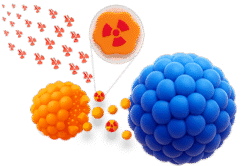
Once the specially designed tracer is injected, the tracer travels through the bloodstream and locates active sites of immune attack, where NK and T immune cells have released granzyme B, which then moves towards cancer tumors. Our CSB-321 radiopharmaceutical drug is formulated to recognize and bind to a tiny portion of the granzyme B biological markers that are present near cancer.[I]Investigational / availability / performance variability. CSB-321 is an investigational agent and has not been approved for commercial use. Availability is limited to clinical studies or other authorized investigational use. Timing, safety, and performance (including frequency of scanning, sensitivity/specificity, and readout intervals) are study, indication, therapy, site, and patient-dependent.
CSB-321 Attaches to Granzyme B
CSB-321 binds extracellular granzyme BAt the immune synapse, the contact point between an immune cell and a tumor cell. to mark where killing activity is occurring.[I]Investigational / availability / performance variability. CSB-321 is an investigational agent and has not been approved for commercial use. Availability is limited to clinical studies or other authorized investigational use. Timing, safety, and performance (including frequency of scanning, sensitivity/specificity, and readout intervals) are study, indication, therapy, site, and patient-dependent.

CSB-321 binds extracellular granzyme BAt the immune synapse, the contact point between an immune cell and a tumor cell. to mark where killing activity is occurring.[I]Investigational / availability / performance variability. CSB-321 is an investigational agent and has not been approved for commercial use. Availability is limited to clinical studies or other authorized investigational use. Timing, safety, and performance (including frequency of scanning, sensitivity/specificity, and readout intervals) are study, indication, therapy, site, and patient-dependent.
PET Scan Imaging
The patient then undergoes a positron emission tomography (PET) scan, a routine imaging procedure that provides a detailed, three-dimensional view of tracer accumulation.
The brief PET scan counts tracer occurrences and reconstructs a whole-body 3D map, showing each hotspot—the locations where granzyme B is attacking tumors.[I]Investigational / availability / performance variability. CSB-321 is an investigational agent and has not been approved for commercial use. Availability is limited to clinical studies or other authorized investigational use. Timing, safety, and performance (including frequency of scanning, sensitivity/specificity, and readout intervals) are study, indication, therapy, site, and patient-dependent.
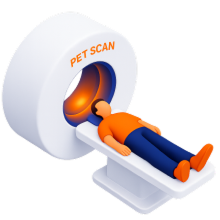
The patient then undergoes a positron emission tomography (PET) scan, a routine imaging procedure that provides a detailed, three-dimensional view of tracer accumulation.
The brief PET scan counts tracer occurrences and reconstructs a whole-body 3D map, showing each hotspot—the locations where granzyme B is attacking tumors.[I]Investigational / availability / performance variability. CSB-321 is an investigational agent and has not been approved for commercial use. Availability is limited to clinical studies or other authorized investigational use. Timing, safety, and performance (including frequency of scanning, sensitivity/specificity, and readout intervals) are study, indication, therapy, site, and patient-dependent.
Granzyme B Levels Revealed
Software outputs tumor-by-tumor (lesion-level) scores, highlighting “hot” vs “cold” sites of immune activity. These quantitative measures (e.g., SUV/TBR per protocol) can be trended visit-to-visit.[I]Investigational / availability / performance variability. CSB-321 is an investigational agent and has not been approved for commercial use. Availability is limited to clinical studies or other authorized investigational use. Timing, safety, and performance (including frequency of scanning, sensitivity/specificity, and readout intervals) are study, indication, therapy, site, and patient-dependent.

Software outputs tumor-by-tumor (lesion-level) scores, highlighting “hot” vs “cold” sites of immune activity. These quantitative measures (e.g., SUV/TBR per protocol) can be trended visit-to-visit.[I]Investigational / availability / performance variability. CSB-321 is an investigational agent and has not been approved for commercial use. Availability is limited to clinical studies or other authorized investigational use. Timing, safety, and performance (including frequency of scanning, sensitivity/specificity, and readout intervals) are study, indication, therapy, site, and patient-dependent.
Early Data Suggests Correlation with Drug Efficacy
In clinical trials to date, CSB-321 uptake has been >95% sensitive and specific for overall response.[IV]Performance metrics. Any stated sensitivity/specificity, or similar metrics reflect study-level results under defined protocols and populations and may not generalize to other indications, sites, or patient cohorts. These scans were performed as early as 14 days after starting therapy.[II]Comparative & timing context. Statements comparing CSB-321 to CT/MRI/FDG or lab markers, and any earlier readout claims (e.g., ≈approximately 14 days), are context-specific to the study protocols (acquisition timing, analysis methods, reader criteria) and do not guarantee individual outcomes, regulatory decisions, or clinical benefits. We are continuing to investigate how we can enable earlier decisions to continue, switch, or stop treatment, and support earlier go/no-go choices in studies.[III]Economic/operational impact. References to cost/time savings, de-risking, shorter trials, and earlier go/no-go reflect potential operational advantages observed or anticipated in studies; they do not guarantee lower overall development costs, faster approvals, or commercial success.
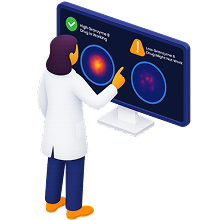
In clinical trials to date, CSB-321 uptake has been >95% sensitive and specific for overall response.[IV]Performance metrics. Any stated sensitivity/specificity, or similar metrics reflect study-level results under defined protocols and populations and may not generalize to other indications, sites, or patient cohorts. These scans were performed as early as 14 days after starting therapy.[II]Comparative & timing context. Statements comparing CSB-321 to CT/MRI/FDG or lab markers, and any earlier readout claims (e.g., ≈approximately 14 days), are context-specific to the study protocols (acquisition timing, analysis methods, reader criteria) and do not guarantee individual outcomes, regulatory decisions, or clinical benefits. We are continuing to investigate how we can enable earlier decisions to continue, switch, or stop treatment, and support earlier go/no-go choices in studies.[III]Economic/operational impact. References to cost/time savings, de-risking, shorter trials, and earlier go/no-go reflect potential operational advantages observed or anticipated in studies; they do not guarantee lower overall development costs, faster approvals, or commercial success.
Radiodiagnostic Related Content
CytoSite Bio Announces Agreement with Lantheus for Granzyme B Targeted PET Imaging Radiotracer for Immunotherapy Assessment
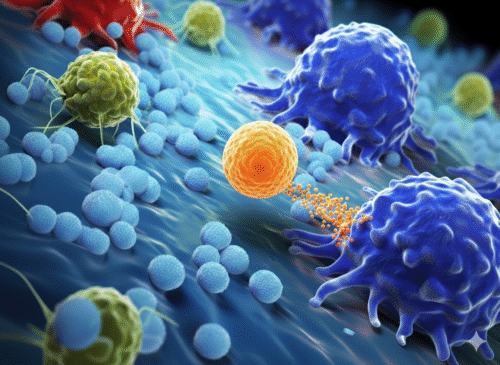
Cytosite Bio Launches Granzyme B Targeted PET Imaging Biopharmaceutical Services Program for Immunotherapy Assessment of Patient in Clinical Trials
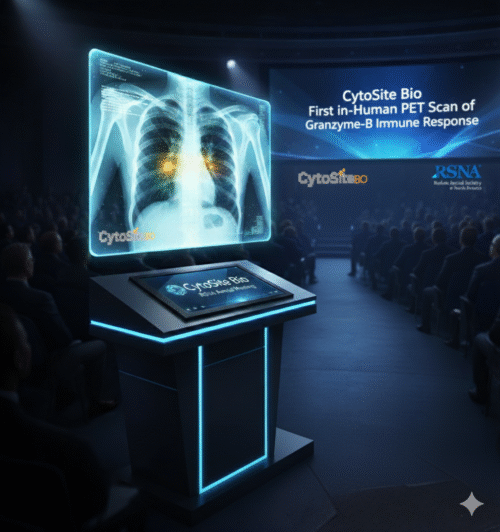
CytoSite Bio Presents First-in-Human Data at Radiological Society of North American Annual Meeting






-
I
Investigational / availability / performance variability. CSB-321 is an investigational agent and has not been approved for commercial use. Availability is limited to clinical studies or other authorized investigational use. Timing, safety, and performance (including frequency of scanning, sensitivity/specificity, and readout intervals) are study, indication, therapy, site, and patient-dependent.
-
II
Comparative & timing context. Statements comparing CSB-321 to CT/MRI/FDG or lab markers, and any earlier readout claims (e.g., ≈approximately 14 days), are context-specific to the study protocols (acquisition timing, analysis methods, reader criteria) and do not guarantee individual outcomes, regulatory decisions, or clinical benefits.
-
III
Economic/operational impact. References to cost/time savings, de-risking, shorter trials, and earlier go/no-go reflect potential operational advantages observed or anticipated in studies; they do not guarantee lower overall development costs, faster approvals, or commercial success.
-
IV
Performance metrics. Any stated sensitivity/specificity, or similar metrics reflect study-level results under defined protocols and populations and may not generalize to other indications, sites, or patient cohorts.
Could Your Pipeline Benefit from a 14-Day Go or No-Go Decision?
Validated therapeutic efficacy with 95% accuracy across 5 cancer types—where advanced diagnostics meets targeted radiotherapy.